
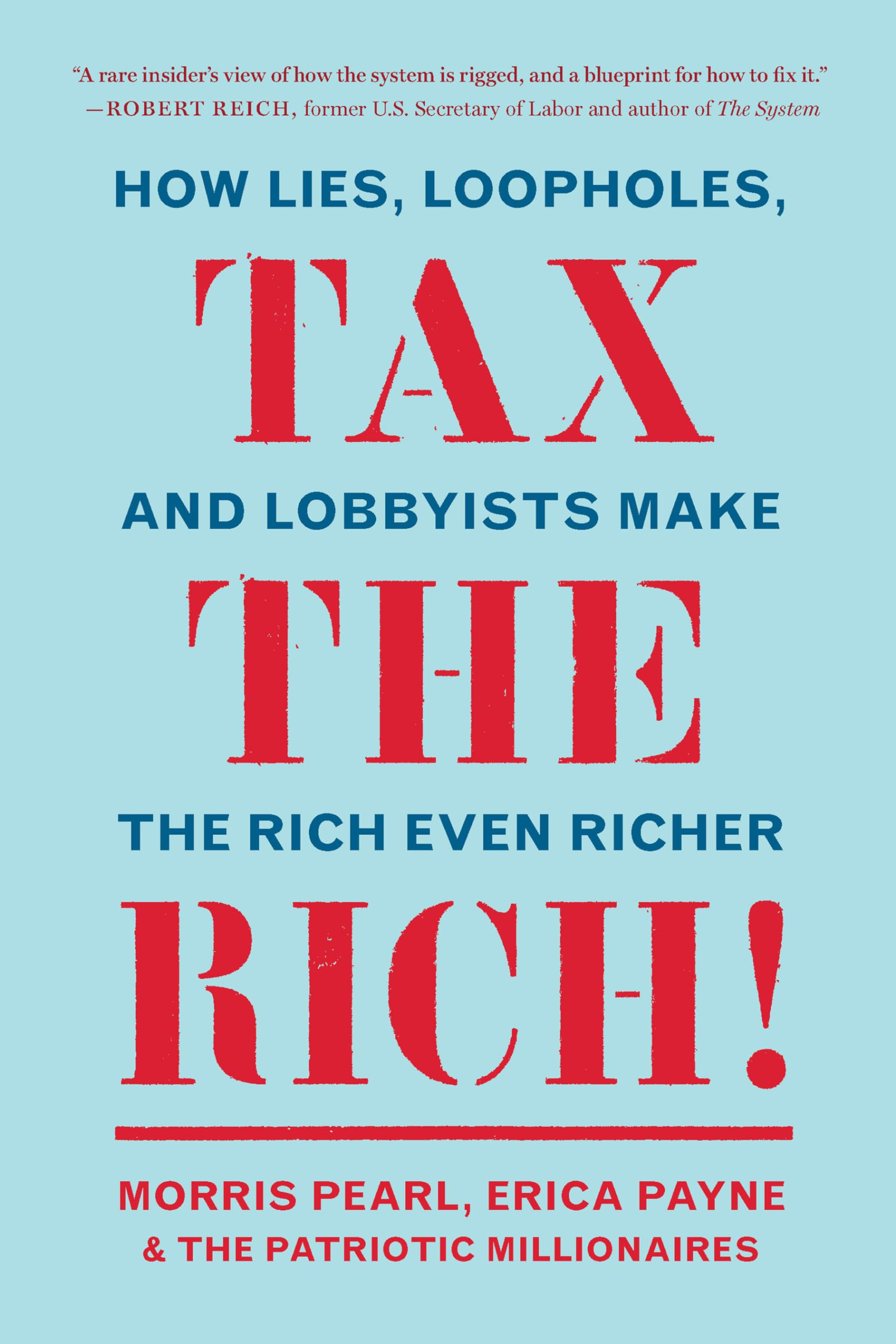
Tax the Rich by Morris Pearl, Erica Payne, and the Patriotic Millionaires
This is an informative and important book that explores how wealthy individuals have manipulated the tax code in the United States over time, contributing significantly to the country's wealth gap.
The book focuses specifically on the new tax and labor act implemented by the Trump administration in 2017. While Canada does not have as many aggressive loopholes and tax avoidance tactics as the U.S., similar issues could emerge if Canada is not vigilant, especially given that many of these problems arose less than a decade ago. It is concerning to think that Canada could face these threats in the future.
Additionally, Corporate America has a global impact, and corporate taxes are part of what enable the likes of Jeff Bezos, Mark Zuckerberg, and Bill Gates to accumulate vast fortunes.
Morris Pearl, a former manager/director at BlackRock, states in the book that he wrote it “in part to change my fellow millionaires and get their heads out of the sand.” Erica Payne, president and founder of the Patriotic Millionaires, emphasizes that “everything—from how much money you bring home to how good your kids' school is to whether or not you die of COVID-19—is partially dependent on how the economy is structured, and the tax system composes much of the structure of the economy.”
The Patriotic Millionaires organization in the U.S. wrote an open letter in 2012 to challenge America’s leaders, protesting the extension of the Bush tax cuts. This letter was signed by 200 individuals in 33 states, highlighting that there are around 500,000 people in the U.S. with incomes over $100 million. The authors argue that the only way to fix the systemic issues in the U.S. is through tax reform.
Canada may need to examine our tax codes, especially since there is an organization called Patriotic Millionaires Canada. Let's compare the significant points in this book with Canada’s tax system to identify any shortcomings.
So, what does "rich" mean? The Patriotic Millionaires organization defines "rich" as individuals with incomes of $1 million and/or assets exceeding $5 million.
There is a distinction between the relatively rich and the ultra-rich! Notably, the combined wealth of Jeff Bezos, Bill Gates, and Mark Zuckerberg is greater than that of the bottom half of the U.S. population, as those three men own more than what is collectively held by 160 million people.
The marginal utility of money refers to the additional satisfaction or benefit a consumer experiences when they consume one more unit of a good or service. This concept helps us understand that for ultra-rich people, the more money they accumulate, the less important each dollar becomes, and it has little effect on their lifestyle. This is not the case for the rest of the world.
The book quotes several members of the Patriotic Millionaires about their views on wealth. One quote came from Jacqueline Boberg, a beneficiary of Silicon Valley startups. She states, “It’s become clear to me that wealth isn’t about going to nice restaurants or fancy stores but about having access to every level of society and any number of special privileges. In the United States, it means having access to all the healthcare I can pay for, access to excellent schools and colleges for my children, and access to influencing the political class through donations.”
Most of us recognize that there is corruption in politics; however, we may not realized how blatantly corrupt the campaign finance system is and how much political power wealthy individuals in the U.S. have over the political economy. The book critiques “the economy” by contrasting common beliefs with the reality of how it functions.
The book explains, “It's easy to see how people get confused and start believing that if the stock market is doing well, then the economy must be doing well, which means that their personal economy (the economy you experience in daily life—wages, cost of living) will improve soon too… Any day now. In reality, it doesn’t work that way at all. The stock market is just a collection of companies, so if those companies' profits increase, their stock prices go up, which means the people who own those stocks become richer (at least on paper).”
“Right now, the economy is delivering most of its gains to an increasingly small group of people who are already incredibly wealthy.”
Investopedia describes the economy as “the large set of interrelated production and consumption activities that aid in determining how scarce resources are allocated. In an economy, the production and consumption of goods and services fulfill the needs of those living and operating within it.
The writer metaphorically refers to the economy as “a machine, not a person.” Over time, human beings have made both big and small changes to our economic system, leading to greater societal inequality.
The societal consequences of this economy are evident: in the U.S., total drug, suicide, and alcohol-related deaths rose from under 30,000 in 1999 to 50,000 in 2018.
Their money versus your sweat!
There are two types of income: labor income and capital income. The book illustrates both types. Labor income (ordinary income) is described as “your sweat”—when someone works full-time for a paycheck, makes $100,000 in ordinary income, and pays $9,000 in taxes.
Capital Gains Income “their money”- passively collects income, makes $100,000 in Capital Gains, pays $0 in taxes.
Wealthy individuals earn a significantly higher percentage of their income from capital gains compared to the average person.
For instance, consider two different couples. The first couple works full-time, putting in 40 hours a week, and earns a household income of $100,000. Under the new Republican tax code, they would owe $8,629 in taxes in addition to FICA (Employment Insurance in Canada) taxes totaling $7,650.
The second couple, on the other hand, spends their year playing golf and enjoying strawberry daiquiris on the beach. They make $100,000 from selling stocks to support themselves for the year. Thanks to a standard deduction of $24,800 and existing tax laws, they end up paying $0 in taxes, as the first $80,000 of investment income is not taxed after deductions.
There is no valid reason for this tax advantage except for the argument that it encourages investors to engage in the market. However, the potential returns from investing are already sufficient motivation.
This situation highlights just a portion of the complex tax strategies discussed in the book, which explains these issues in greater detail.
Tax Trick #1 - Carried Interest (The Billionaire Loophole)
United States
Carried interest allows fund managers to tax their labor income as capital income, which is often referred to as "the billionaire loophole."
The fund is typically set up as a limited partnership with performance-based compensation (carried interest). This structure allows for flow-through treatment—meaning that fund managers receive a share of the profits (the carried interest—partnership allocation).
Canada
In Canada, there is a similar loophole known as "partnership profit allocation" or the "private equity loophole." Although Canada's version is less formalized, it functions similarly: labor-based compensation can be taxed as capital gains. As a result, fund managers in both countries pay significantly less tax on their labor, by as much as 50% less in Canada!
While capital gains elections are denied to traders and dealers, the partnership profit allocation loophole can circumvent this rule.
Regarding the Goods and Services Tax (GST) and Harmonized Sales Tax (HST), most financial services are exempt from GST/HST. These include activities such as issuing financial instruments, transferring money, or managing investments. However, the Act lists certain exclusions where specific activities are not deemed financial services and are therefore taxable. These taxes are often hidden within the product rather than being transparently charged.
Tax Trick #2 - Estate Tax: How We Created the American Aristocracy
United States
In the U.S., 35-45% of all wealth is inherited. As of 2020, the estate tax exemption rate was $11.58 million for individuals. Married couples can combine their exemptions (totaling $23.66 million) tax-free. Any amount above this threshold is taxed at a rate of 40%. In 2001, the exemption was only $675,000 per person, but the threshold was doubled in 2017, rising from $5.59 million to $11.2 million per person under the Trump tax code.
In contrast, Canada does not have an estate or inheritance tax. Instead, they apply a "deemed disposition at death," which triggers capital gains taxes on the estate.
The Capital Gains Inclusion Rate refers to the percentage of profit from selling an asset (capital gain) that is added to your taxable income and taxed at your marginal rate. For example, a 50% inclusion rate means that half of the capital gains are taxable.
Canada
In Canada, there is also a probate fee, which is an administrative fee for the government to provide a probated will, making it more difficult to contest. This probate fee is 1.5% of total assets above a certain limit, and executors and beneficiaries often find it confusing and frustrating.
The Capital Gains Inclusion Rate in Canada is 50% initially, increasing to 66.67% thereafter. Compared to the higher top marginal rates on regular income, this results in a lower effective rate than the U.S. estate tax rates.
Tax Trick #3 - Side-Stepping Taxes: The Stepped-Up Basis
United States
In the U.S., the basis of an asset is the fair market value at the time of realized gain. In Canada, fair market value refers to the price an asset would sell for today under normal market conditions.
The basis is "stepped up" to the current market value at death, meaning the estate avoids all capital gains taxes on profits earned during the deceased's lifetime.
These loopholes are designed to facilitate significant intergenerational wealth transfers, often allowing individuals to inherit what some might call "free money" in a country founded on the idea of equality among people.
Canada
Fortunately, Canada does not have a stepped-up basis; instead, they utilize exemptions such as allowing a principal residence to be passed on to heirs tax-free. This is particularly generous, especially if the property’s value has increased significantly. In addition, Canada has mechanisms that allow certain wealth to be transferred tax-free. For example, the spousal rollover permits assets to pass to a surviving spouse tax-deferred, and business owners often employ estate freezes to lock in current value while shifting future growth to heirs. The Lifetime Capital Gains Exemption shields over a million dollars of gains on qualifying small-business or farm property. While these tools don’t eliminate tax the way a stepped-up basis does, they provide some similar benefits for wealthy individuals.
Overall, this highlights the need for an Intergenerational Wealth Transfer tax in the U.S., Canada, and potentially worldwide!
4. Annuity Trusts: Don't Trust This System
United States
In the U.S., it's known as a Grantor Retained Annuity Trust (GRAT), which is a fixed-term irrevocable trust that helps avoid estate and gift taxes while providing tax-free gains. The trust typically has beneficiaries, who are often children and grandchildren. If the amount were given directly to the beneficiary, it would be subject to gift tax.
Canada
In Canada, similar wealth-transfer goals can be achieved through estate freezes, family trusts, and cross-border foreign grantor (“Granny”) trusts when applicable. My thoughts: If you've heard the term “Trust Fund Baby,” this is what they are referring to!
5. Let’s Play Switch and Swap: The 1031 Like-Kind Exchange
United States
This strategy is favored by a certain real estate developer who later became the President of the U.S. The 1031 exchange, also known as the like-kind exchange, allows investors to defer paying capital gains taxes when they sell a property. Real estate owners can delay paying capital gains taxes on the sale of a property as long as the money from that sale is immediately reinvested into a similar property or properties.
Canada
In Canada, there is only partial and situational deferral, not a reinvestment-based tax rollover. The combined tax loophole often utilized is the 1031 exchange, along with the stepped-up basis.
6. Opportunity Zones
United States
Opportunity Zones are a U.S. federal tax incentive program created in 2017 to encourage long-term private investment in economically distressed communities. This means that investors can avoid paying taxes on their profits if they invest in an opportunity zone for up to 7 years, with zero taxes on property after 10 years of investment. However, most Opportunity Zones are located in gentrified areas (such as parts of New York) that do not need financial assistance, allowing developers to pocket tax breaks on luxury condos and expensive hotels.
Canada
Municipal or provincial property/land-use incentives in some provinces and cities, but these are not nationwide and don’t mirror U.S. OZ capital‑gains tax treatment.
There are Federal and Provincial tax credits and incentives that target specific sectors or objectives.
7. Pass-Through Income
United States
Small business owners can deduct 20% of their business personal income through LLCs and partnerships. However, 85% of pass-through income goes to the top 20% of earners, and more than 50% goes to the top 1%. This trend is highlighted by the President Trump Tax Cuts and Jobs Act of 2017, which reduced the corporate profit tax rate from 35% to 21%. There is a pressing need for a cultural change within corporate America.
In partnerships, income is generally passed through to individual partners, but this is not considered a loophole.
Canada
In Canada, partnerships do not pay tax themselves; instead, they allocate income to partners who pay taxes at their own rates. While this is similar to U.S. partnerships, Canada does not allow for the same aggressive special allocations or entity-level elections that create U.S. loopholes. Canada permits some flow-through taxation via partnerships and trusts, but it does not have the U.S. corporate pass-through loophole. Corporate income in Canada is always taxed at the corporate level, and strict anti-avoidance rules prevent the kind of income-shifting strategies that are common in the U.S.
Corporate Trick #1: Multinational Money Gamers - International Profit Shifting
This involves moving intellectual property (such as a logo) from the U.S. to a tax-preferential country (like Ireland, with a tax rate of 12.5%). Only wealthy corporations can take advantage of this arrangement.
Canadian companies can share profits with foreign subsidiaries, affiliates, or parent companies, but the tax rules are structured to prevent base erosion, income stripping, and the artificial shifting of profits to low-tax jurisdictions. Canada does allow for multinational corporate groups, cross-border dividends, transfer pricing arrangements, cost-sharing agreements, intercompany loans, and royalties; however, all of these are subject to strict anti-avoidance rules.
Corporate Trick #2: New Territorial Tax System
When people refer to the New Territorial Tax System, they are discussing the major shift in U.S. international tax rules introduced in 2017. Before this change, the U.S. used a worldwide tax system, meaning U.S. corporations owed U.S. tax on all income, regardless of where it was earned (with credits for foreign taxes).
Under the new system, international profits are taxed at 10.5% instead of 21%, effectively providing a “50% off coupon.” Companies still receive a U.S. revenue credit for 80% of the taxes paid to foreign governments. This new rate is less than a third of the old corporate tax code. Thus, companies would owe 15% to the U.S. on profits of 20%, with no taxes owed on foreign profits.
Canada already operates a sort of territorial tax system, so this 2017 shift was intended to align the U.S. with OECD norms. Think of OECD norms as the global rulebook for how advanced economies should structure their tax systems.
Corporate Trick #3 Relocating Assets Overseas
Tangible assets, such as factories and equipment, can be relocated overseas. In the U.S., corporate profits are only taxed above a "routine" rate of return on physical assets held overseas. This tax applies at a rate of 10% for every $10 million in tangible assets outside the country.
The first million dollars in profits earned tax-free overseas are not beneficial for job creation or the tax system. In Canada, the taxation system already exempts foreign active business income, which reduces the incentive to shift factories or equipment offshore for tax benefits. Consequently, Canadian tax avoidance strategies tend to focus on the following:
- Intellectual Property (IP) migration
- Financing structures
- Treaty shopping
- Hybrid entities
- Transfer pricing on intangibles
Corporate Trick #4 Stock Options for Executives
Stock options give employees the right to purchase shares at a predetermined price, typically the price at the time the company grants the reward. Executives often receive lavish stock option packages. For instance, Facebook granted 600 million stock options at $0.06 each when the stock was trading at $38 per share. When Mark Zuckerberg exercised his options in 2012, it resulted in a cancellation of Facebook’s reported profits of $1.1 billion, and the company received $429,000 in refunds.
Here's an example: If an employee receives 1,000 options at $50 per share, after three years, if the share price rises to $80 per share, the employee can buy the option at $50 and immediately sell it for $80. The corporation can then deduct the difference.
Corporate Trick #5 Accelerated Depreciation: The Largest Domestic Tax Break for American Corporations
Under the Trump administration in 2017, 100% first-year deductions for asset depreciation were introduced. This allows businesses to deduct the entire depreciation amount in the first year, instead of following the standard depreciation schedule (which typically spans 10 years). Essentially, this serves as a loan from the government, allowing companies to invest the refund received from the deduction over those 10 years instead of paying taxes based on the correct depreciation schedule.
Some assets qualify for bonus depreciation of up to 50% of their entire value in the year they are purchased. For example, Amazon reported $0 in federal taxes on $11.26 billion in profits due to:
- International profit sharing
- Stock options deductions
- Accelerated depreciation
- Canadian corporations utilize similar strategies
Corporate Lie#1: Corporate Tax Cuts Create Jobs
The claim that corporate tax cuts create jobs is misleading. Companies that avoid taxes while being profitable often reduce jobs. Between 2008 and 2016, the average job growth in the U.S. private sector was 6%, while profitable corporations that paid less than a 20% effective tax rate did not contribute significantly to job growth.
Corporate Lie #2: Private Equity Investors are Job Creators
Private equity investors often take over businesses, reorganize them, extract value, and sell them off, benefiting from the carried interest loophole through lobbying. They are not true job creators.
Corporate Lie#3 Relocating Assets Overseas
Tangible assets, such as factories and equipment, can be relocated overseas. In the U.S., corporate profits are only taxed above a "routine" rate of return on physical assets held overseas. This tax applies at a rate of 10% for every $10 million in tangible assets outside the country.
The first million dollars in profits earned tax-free overseas are not beneficial for job creation or the tax system. In Canada, the taxation system already exempts foreign active business income, which reduces the incentive to shift factories or equipment offshore for tax benefits. Consequently, Canadian tax avoidance strategies tend to focus on the following:
- Intellectual Property (IP) migration
- Financing structures
- Treaty shopping
- Hybrid entities
- Transfer pricing on intangibles
Corporate Lie #4 Stock Options for Executives
Stock options give employees the right to purchase shares at a predetermined price, typically the price at the time the company grants the reward. Executives often receive lavish stock option packages. For instance, Facebook granted 600 million stock options at $0.06 each when the stock was trading at $38 per share. When Mark Zuckerberg exercised his options in 2012, it resulted in a cancellation of Facebook’s reported profits of $1.1 billion, and the company received $429,000 in refunds.
Here's an example: If an employee receives 1,000 options at $50 per share, after three years, if the share price rises to $80 per share, the employee can buy the option at $50 and immediately sell it for $80. The corporation can then deduct the difference.
Corporate Lie #5 Accelerated Depreciation: The Largest Domestic Tax Break for American Corporations
Under the Trump administration in 2017, 100% first-year deductions for asset depreciation were introduced. This allows businesses to deduct the entire depreciation amount in the first year, instead of following the standard depreciation schedule (which typically spans 10 years). Essentially, this serves as a loan from the government, allowing companies to invest the refund received from the deduction over those 10 years instead of paying taxes based on the correct depreciation schedule.
Some assets qualify for bonus depreciation of up to 50% of their entire value in the year they are purchased. For example, Amazon reported $0 in federal taxes on $11.26 billion in profits due to:
- International profit sharing
- Stock options deductions
- Accelerated depreciation
Canadian corporations utilize similar strategies.
Wealthy individuals often hire friends to manage foundations, offering high-paying positions that enhance the donors' reputations. These foundations frequently advocate for public policies that serve the financial interests of their benefactors. For instance, some people spend $60,000 on portraits of influential figures like former President Trump.
This practice can be seen as "reputation laundering" using charitable donations to distract from other harmful behaviors. The idea is to donate to a good cause, so people forget about the negative actions associated with you. Modern philanthropy can be perceived as a way to cover up the shortcomings of the wealthiest 1%.
Corporate Lie #7: "It's Their Money."
Between 35% to 45% of all wealth in America is inherited. Additionally, many industry giants have received significant advantages from their parents and from government-funded resources that helped pave their paths to success, such as the internet, educational institutions, and infrastructure. No one becomes successful in a vacuum.
Corporate Lie #8: Politicians Care as Much About Their Constituents as They Do About Their Donors
Most members of Congress spend more time fundraising than they do legislating. Their frequent interactions with wealthy individuals can lead to legislation that favors the interests of the rich. In 2020 alone, over $10 billion was spent on political advertising. The top 1% of the 1% (0.01%) accounted for one-third of all political spending.
This represents a clear case of corruption. Some politicians may unintentionally skew their perspectives due to the time they spend with wealthy donors, while others are blatantly corrupt. For example, a donor might ask a politician to change specific legislation in exchange for a generous contribution to the politician's re-election campaign.
The Koch brothers, who own a billion-dollar oil refinery, created one of the most powerful right-wing groups, which organizes think tanks and climate change skeptic groups. They also donated $500,000 to a congressman's political action committee (PAC) after the Republican tax code was passed in the House. Moreover, they pledged $20 million to help market this tax bill, which is estimated to have the potential to net them $1.4 billion due to the changes in the tax code.
Political spending is often an investment aimed at securing future earnings. Donors strategically fund campaigns that spark social debates—like abortion or immigration—to help elect lawmakers who favor tax cuts. This is part of a conservative playbook.
The tax system can be compared to Coca-Cola—it's harmful but profitable for those who benefit from it.
A study by Princeton professor Martin Gilens, covering the years from 1980 to 2010, found that policies supported by the wealthy, businesses, and special interest lobbyists were passed 60% to 70% of the time. In contrast, only 30% of policies supported by majority votes were enacted— and only if they were also backed by businesses. Not a single policy promoted by a majority vote but opposed by the wealthy was ever passed.
Corporate Lie #9: Tax Cuts for Wealthy Individuals Will Benefit Everyone
The reality is that wealth trickles up from poor people to the rich when low-income individuals purchase goods from companies owned by the wealthy.
Money transfers from your bank account to the investors' accounts through dividends and other returns from the companies whose products you buy.
Corporate Lie #7: We Should Trust Wealthy Individuals
Even if wealthy individuals claim they want to pay higher taxes, actions speak louder than words.
Unrigging the Economy:
Equalize Capital Gains and Ordinary Income Tax Rates for Incomes Over $1 Million
It is crucial that working Americans pay less in taxes than wealthy individuals who primarily earn from investment income.
End the "Bracket Racket"
Create more tax brackets with significantly higher rates. A significant majority (59%) of registered voters support raising the top income tax rate to 70%, with 45% of Republicans backing this change. Only wealthy lobbyists oppose it.
Implement More Tax Brackets with Rates Up to 90% for Extreme Wealth
Apply marginal taxation, which refers to the percentage of tax paid on each additional dollar of income within a specific tax bracket, not your total income.
While moving into a higher bracket, only the amounts within that bracket are taxed at that higher rate; thus, your effective tax rate (the overall rate you pay) is always lower than your highest marginal tax rate.
Tax the Rich!
Implement a Wealth Tax
Increase Taxes on Income, Capital Gains, and Large Estates
This initiative aims to curb the growth of wealth inequality in America by limiting the further accumulation of wealth by dynastic families. For instance, the three richest people in the country hold more wealth than the bottom half of all Americans combined—over 150 million people.
Understanding the Wealth Tax
A wealth tax levies a percentage on the total value of everything a wealthy person owns, calculated by subtracting liabilities from assets. This tax will not push anyone into poverty.
Addressing Compound Interest
Once someone is extremely wealthy, it becomes nearly impossible to spend enough to diminish their fortune. A wealth tax functions similarly to a property tax. For many middle-class Americans, their wealth is primarily tied up in their homes; however, for the top 1%, primary residences represent just 7.6% of their total wealth.
According to studies, the wealthiest 10% of income earners pay less than 2% of their income in property taxes each year, while the poorest 10% pay nearly 5% of their income in property taxes. Furthermore, wealthy individuals own many assets that currently go untaxed, allowing them to accumulate wealth without paying their fair share.
Reform Capital Gains Taxation
Currently, investors can defer taxes on capital gains until their investments are sold. In contrast, labor income is typically withheld biweekly from paychecks. This delay, combined with the "stepped-up basis" rule, significantly contributes to wealth inequality.
There should be a "mark-to-market" taxation system, which would tax rich individuals every year based on the increased value of their assets. This reform would prevent wealthy individuals from controlling when they pay taxes on capital gains, enabling them to offset losses with gains and potentially avoid taxes throughout their lives. Additionally, under the current stepped-up basis rule, their tax obligations can be completely erased when assets are inherited by their heirs.
Wealthy individuals grow richer by investing money that would otherwise go to taxes.
Make Corporations Pay Taxes Where They Actually Earn Their Profits: End Profit Shifting.
We need to change the rules to prevent corporations from claiming tax deductions for money they transfer to their foreign subsidiaries. These foreign entities often exist solely for tax avoidance.
It's time to ensure that corporations truly pay their fair share. We also need to adequately fund the IRS. Conservative legislators who oppose taxes have targeted the IRS for budget cuts, which has hindered its ability to effectively identify tax evasion. As a result, tax evasion has surged, particularly among the wealthiest 1%.
When the interests of the wealthy are pitted against the well-being of the general population, the wealthy tend to prevail more often than not.
Consumer demand is the true engine of job creation.
According to the UN World Happiness Report, countries with the most progressive tax systems and equitable returns are the happiest.